Mobile app development company in Dubai for iOS and Android
An app earns its place on a customer's phone only if it does one job better than your website can: faster booking, easier reordering, a loyalty card that actually gets used. NetSoft is a mobile app development company in Dubai that plans, designs and builds iPhone and Android apps around that job, with the back end, Arabic and English support, payments and notifications they need, and then gets them through App Store and Google Play review.
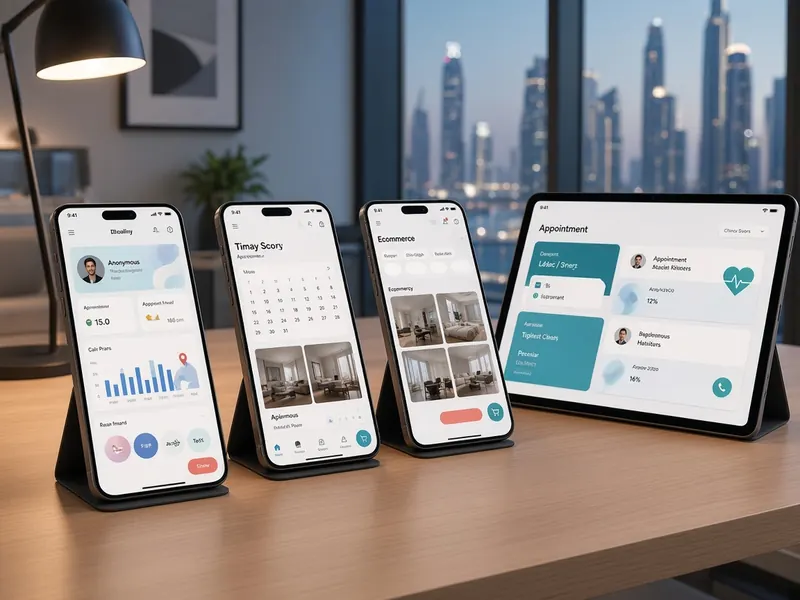
Bespoke Mobile Application Development Dubai
You work with one in-house team from the first scoping call to release and the updates after it. We choose native or cross-platform development on the facts of your product, test on real devices, and keep the code and the store accounts in your company's name.
Strategy + Engineering + Testing = An App People Keep Using
What our app developers in Dubai build
Most of the apps we are asked about fall into a few types. Each needs a different launch scope.
Customer and booking apps
Appointments, reservations, service requests and account areas, with push notifications for reminders and updates. Common for clinics, hospitality and service businesses that want customers to rebook without calling.
Shopping and ordering apps
Product browsing, carts, saved addresses, order tracking and reorders, connected to the store or ordering system you already run. If your store is still being built, start with our ecommerce website development page.
Internal and field-team apps
Apps for staff rather than customers: job lists, checklists, photo uploads, approvals and dashboards, connected to the systems your operations team already uses.
Companion apps for an existing platform
When you already have a web platform, an app can reuse its accounts and data through APIs, so customers get the mobile experience without a second system to maintain.
Progressive web apps as a first step
Not every business needs a store app on day one. A progressive web app installs from the browser, works on weak connections and sends notifications, and can be a sensible first release before a full app.
Native or cross-platform: choosing how to build
The right approach depends on your features, budget and roadmap, not on fashion. We recommend one after discovery and explain why.
Native iOS and Android
Separate apps written in Swift for iPhone and iPad and Kotlin for Android. Native suits apps that lean heavily on device features, complex animation or top performance. See iOS app development and Android app development.
Cross-platform with Flutter or React Native
One shared codebase for both platforms, which is usually faster and more economical for business, booking and shopping apps. Flutter keeps a custom design identical on both platforms; React Native suits teams with JavaScript skills and web code to share. See Flutter app development and React Native app development.
Hybrid and web-based apps
Built with web technology inside a native shell, a practical option when a well-structured web app already exists. See hybrid app development.
Arabic apps that work right-to-left
An Arabic app is more than translated strings. Navigation, gestures, icons, forms, keyboards and notifications all have to behave correctly right-to-left, and Arabic text needs fonts and line spacing that stay readable on a small screen.
We plan both languages from the first screen design. In practice that means:
- layouts that genuinely mirror for RTL, including tab bars, back arrows, swipe actions and progress steps;
- Arabic typography chosen and sized for mobile reading;
- language switching that remembers the user’s choice and keeps them on the same screen;
- Arabic content written or reviewed natively, including push notifications, emails and store listings;
- testing in both languages on real iPhone and Android devices before release.
The same thinking applies to websites; see our bilingual Arabic and English website design page.
Back end, APIs and integrations
The app on the phone is only half the product. The back end stores users and data, sends notifications and connects to everything else. We build and connect:
- APIs and back ends on Node.js, Laravel or Ruby on Rails, or Firebase where a managed back end fits;
- admin panels so your team can manage content, users and orders without a developer;
- payments, including Apple Pay and Google Pay, through your payment provider;
- push notifications, maps and sign in with Apple, where the product needs them;
- links to your existing systems, such as your website, store, CRM or WhatsApp.
Deeper system work is covered on our back-end development, Laravel development and Ruby on Rails development pages.
How an app project runs
We follow four clear steps, the same ones described on our About page, adapted for apps.
Discovery and launch scope
We define the core user journey, the features for the first release and what can wait. The output is a written scope, screen list and timeline.
UX and interface design
Screens designed in Figma in Arabic and English together, with clickable prototypes for review before development. Our UI/UX design team leads this stage.
Build and device testing
App and back-end development in agreed milestones, with test builds you can install on your own phone, and testing across real devices, screen sizes and operating system versions.
Store release and support
Submission to the App Store and Google Play, responses to review feedback, release, then monitoring and updates under a support plan.
Typical timelines
- Progressive web apps typically take 3 to 8 weeks.
- Focused iOS, Android or cross-platform apps typically take 8 to 16 weeks.
- Larger products take up to 20 weeks or are released in phases.
The schedule for your app is confirmed in your written proposal after discovery, and depends on scope, integrations and how quickly feedback comes back.
What affects the cost of an app
We do not publish a starting price for apps. Every app is quoted from a written scope after discovery, so you know what is included before you commit. The main factors are:
- Platforms. One cross-platform codebase or separate native apps.
- Number of screens and features. Accounts, booking, payments, chat, maps and offline use each add design, development and testing.
- Back end. Whether the app needs a new back end and admin panel or connects to an existing one.
- Integrations. Each payment, CRM, ERP or other system connection is built and tested on its own.
- Languages. Arabic and English designed together, including RTL layouts and Arabic store listings.
- Design depth. Custom interface and animation versus standard platform components.
- Support after launch. Operating system updates, monitoring and new releases.
Tell us what you want the app to do, and after a short discovery we send a fixed estimate rather than an open-ended hourly figure.
Publishing to the App Store and Google Play
Getting an app approved is a project step of its own, and we plan for it from the start.
- Developer accounts in your name. The Apple Developer and Google Play Console accounts are set up under your company, so you own the app and its listing.
- Store-ready builds. Signing, privacy details, screenshots and descriptions in both languages are prepared before submission.
- Beta testing. Test builds through TestFlight and Google Play testing tracks, so your team can try the app before customers do.
- Review responses. If Apple or Google asks for changes, we handle the correspondence and fixes.
- Release management. Staged releases and updates, so a problem can be caught before it reaches every user.
Once the app is live, store listings can be improved over time with app store optimization.
Sectors that often need an app
The app ideas we discuss most often come from a few sectors. Each has different needs:
- Healthcare: appointment booking, patient information and reminders, with content that stays accurate. See healthcare website design in the UAE.
- Real estate: saved searches, listing alerts and enquiry flows for brokerages and developers. See real estate website design in Dubai.
- Hospitality: ordering, reservations and loyalty for cafés, restaurants and stays. See hospitality.
- Education: student and parent apps for schedules, notices and admissions. See institutional education.
- Charter and rental: availability, booking and deposits for yachts, cars and fleets. See charter and rental.
- Retail and ecommerce: shopping, reorders and loyalty. See ecommerce.
After launch: support, updates and ownership
Apps need care after release: Apple and Google update their operating systems every year, devices change and users ask for new features. NetSoft does not hand over and disappear:
- One accountable team. The in-house team that builds your app is the team that supports it.
- A direct line. Questions and bug reports go straight to the team by call, WhatsApp or email.
- Tested before every release. Each update is checked on real devices in both languages before it reaches the stores.
- You own the code and the accounts. Source code, back end and the store accounts belong to your company, as written in your scope.
- Back end and hosting looked after. Servers, APIs and admin panels are monitored and maintained, with hosting from the same team if you want it.
- Improvements based on use. Analytics show which features people use, which guides the next release.
Technologies we work with
| Need | Technologies |
|---|---|
| iPhone and iPad (native) | Swift, SwiftUI, UIKit, Xcode, TestFlight |
| Android (native) | Kotlin, Jetpack Compose, Android SDK, Play Console |
| Cross-platform | Flutter (Dart), React Native (TypeScript, Expo) |
| Hybrid and web-based | Ionic, Capacitor, progressive web apps |
| Back end and APIs | Node.js, Laravel, Ruby on Rails, Firebase, REST and GraphQL APIs |
| Design and release | Figma, Codemagic, Fastlane |
We recommend the stack after discovery, based on your features, budget and who will maintain the app. If a progressive web app or a better website would meet the need sooner, we will tell you.
Start your app project
Tell us what you want the app to do, who will use it and which systems it needs to connect to. We will reply with questions, then a written scope and timeline. NetSoft has worked with UAE and GCC businesses since 2005, from Boulevard Plaza Tower 1, Level 9, Downtown Dubai. We are available Monday to Saturday, 9:00 to 18:00 GST. Call or WhatsApp +971 50 219 4018, or email info@dubaiwebcity.com.